Currently Empty: ₹0.00
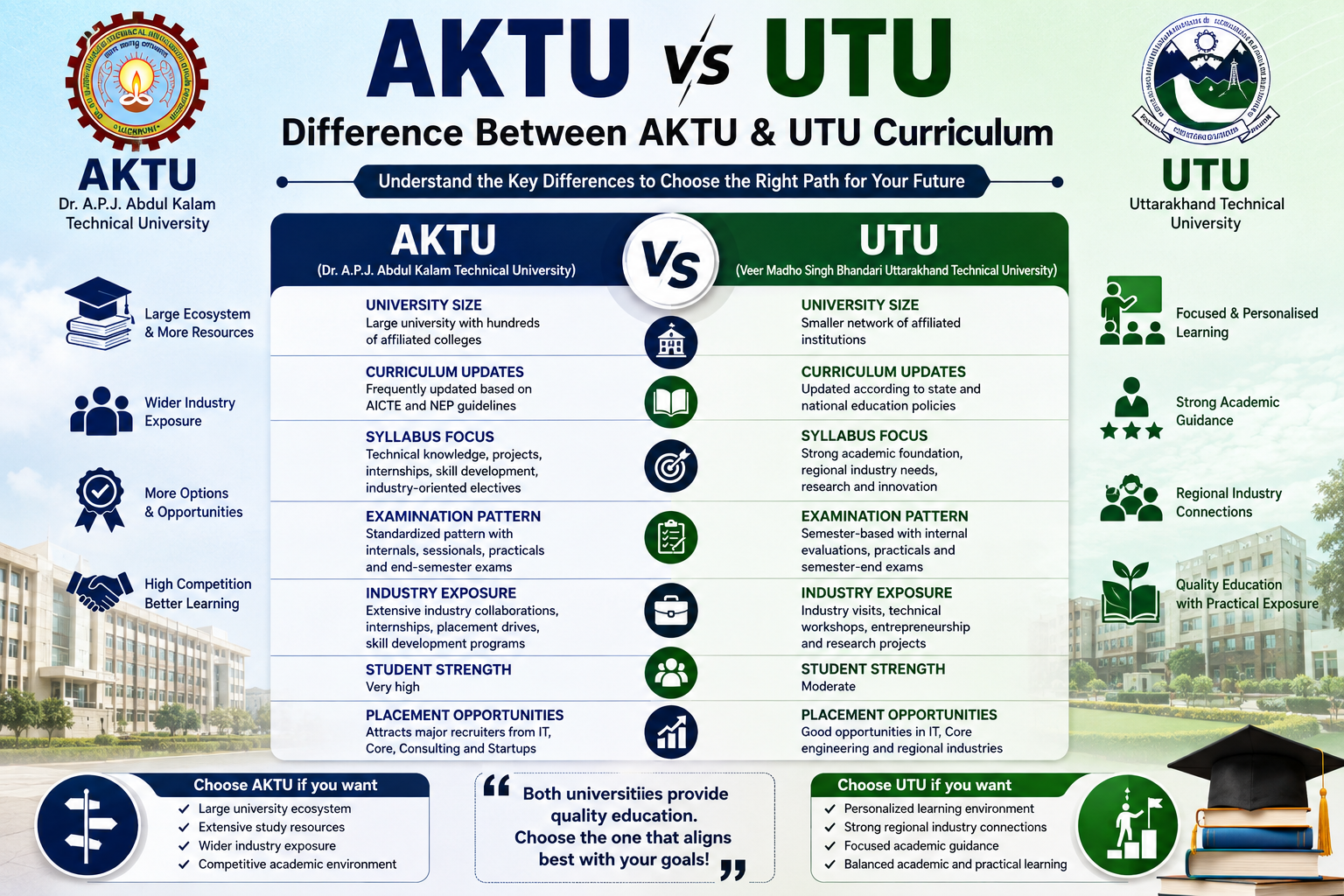
Students often compare AKTU vs UTU when choosing colleges and planning their higher education journey. Both universities offer engineering, management, pharmacy, and professional programs, but their curriculum structure, examination methods, and academic approaches differ in several ways.
Understanding these differences can help students make informed academic and career decisions.
Overview of AKTU and UTU
AKTU (Dr. A.P.J. Abdul Kalam Technical University)
AKTU is one of India’s largest technical universities, headquartered in Lucknow, Uttar Pradesh. It is affiliated with hundreds of engineering, management, pharmacy, and architecture colleges across Uttar Pradesh.
UTU (Uttarakhand Technical University)
UTU, now known as Veer Madho Singh Bhandari Uttarakhand Technical University, is the primary technical university of Uttarakhand and oversees engineering, management, pharmacy, and professional education institutions within the state.
AKTU vs UTU: Curriculum Comparison
| Feature | AKTU | UTU |
|---|---|---|
| University Size | Large university with hundreds of affiliated colleges | Smaller network of affiliated institutions |
| Curriculum Updates | Frequently updated based on AICTE and NEP guidelines | Updated according to state and national education policies |
| Industry Exposure | Extensive due to large industry collaborations | Growing focus on industry interaction |
| Examination Pattern | Standardized across a large number of colleges | Relatively flexible implementation |
| Student Strength | Very high | Moderate |
| Academic Resources | Large repository of study material and resources | Focused academic support system |
Syllabus Structure
AKTU Curriculum
The AKTU curriculum emphasizes:
- Technical knowledge and practical applications
- Universal Human Values courses
- Project-based learning
- Internship requirements
- Skill development and employability training
- Industry-oriented elective subjects
UTU Curriculum
The UTU curriculum focuses on:
- Strong academic foundations
- Regional industry requirements
- Professional development
- Research and innovation activities
- Practical laboratory exposure
- Emerging technology subjects
Examination Pattern
AKTU Examination System
AKTU follows a structured semester examination system that includes:
- Internal assessments
- Sessionals
- Practical examinations
- End-semester theory examinations
- Project evaluations
UTU Examination System
UTU also follows a semester-based examination structure with:
- Internal evaluations
- Practical assessments
- Semester-end examinations
- Project work and presentations
Industry Exposure and Training
One of the important aspects of the AKTU vs UTU comparison is industry interaction.
AKTU
AKTU has partnerships with numerous organizations and frequently organizes:
- Internship programs
- Skill development workshops
- Placement drives
- Industry certification courses
UTU
UTU encourages:
- Industry visits
- Technical workshops
- Entrepreneurship programs
- Research-based projects
Placement Opportunities
AKTU
Due to its large student base and extensive network of affiliated colleges, AKTU often attracts major recruiters from:
- IT sector
- Manufacturing industry
- Consulting firms
- Startups
UTU
UTU students also receive placement opportunities, particularly in:
- IT companies
- Core engineering sectors
- Government projects
- Regional industries
Which Curriculum is Better?
The answer depends on individual goals.
Choose AKTU if you prefer:
- A larger university ecosystem
- Extensive study resources
- Wider industry exposure
- Competitive academic environment
Choose UTU if you prefer:
- Smaller academic ecosystem
- Personalized learning environment
- Strong regional industry connections
- Focused academic guidance
Conclusion
When comparing AKTU vs UTU, both universities provide quality technical education and follow modern academic frameworks. AKTU offers a larger ecosystem with broader exposure, while UTU provides a focused learning environment with strong regional relevance. Students should evaluate factors such as college quality, faculty, placement records, and personal career goals before making a decision.