Currently Empty: ₹0.00
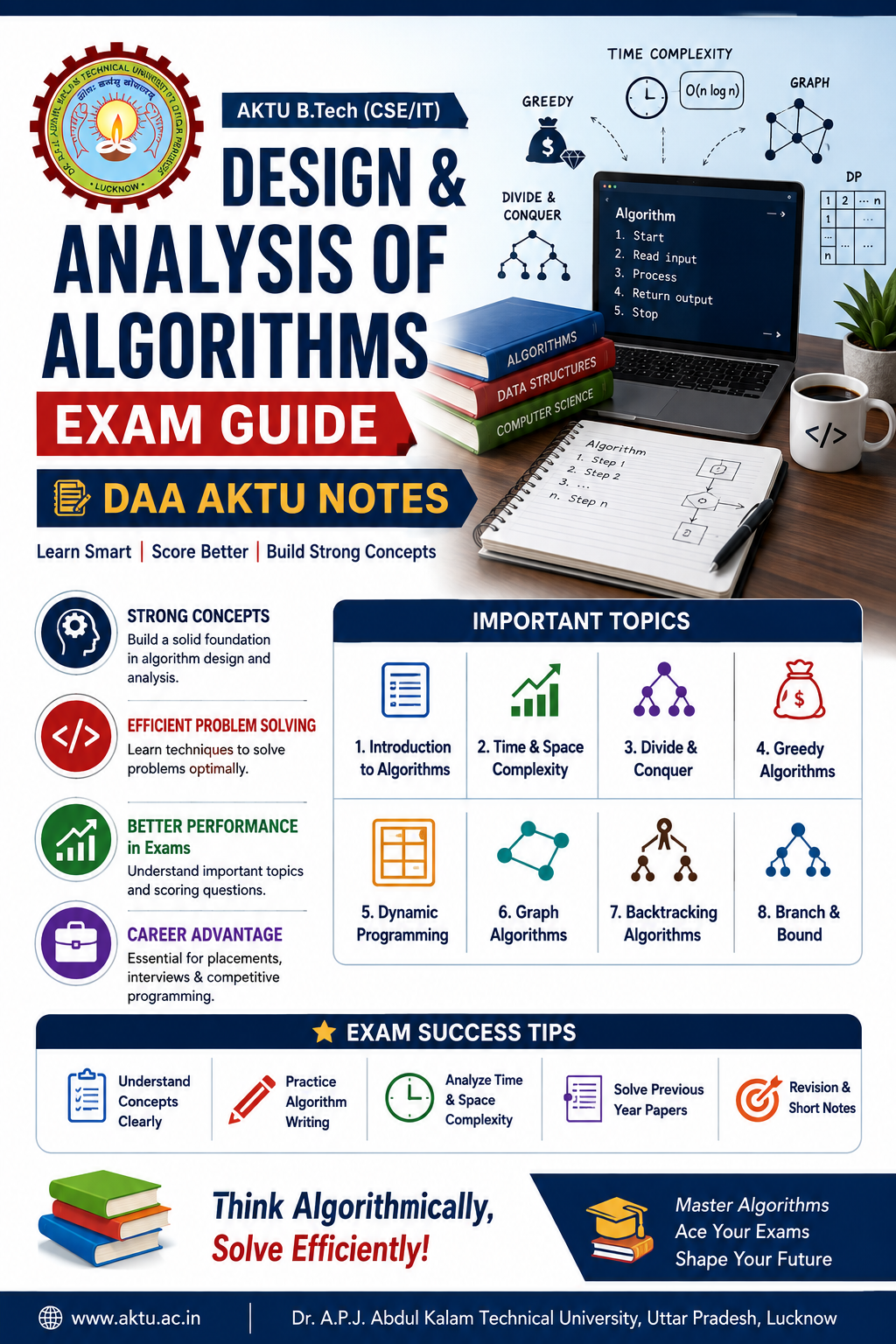
For Computer Science and Information Technology students, Design and Analysis of Algorithms (DAA) is one of the most important subjects in the AKTU curriculum. It forms the foundation of efficient software development, competitive programming, and technical interview preparation.
Many students find DAA challenging because it combines mathematical analysis with programming concepts. However, with the right strategy and quality DAA AKTU Notes, students can easily understand the subject and score well in examinations.
This guide covers the most important topics, exam preparation tips, and concepts every AKTU student should know.
What is Design and Analysis of Algorithms?
An algorithm is a step-by-step procedure used to solve a problem efficiently. The primary goal of Design and Analysis of Algorithms is to develop solutions that use minimum time and memory resources.
The subject focuses on:
- Algorithm design techniques
- Time complexity analysis
- Space complexity analysis
- Problem-solving approaches
- Optimization methods
- Computational efficiency
DAA helps students understand how to choose the best algorithm for a particular problem.
Why is DAA Important?
DAA is not just an academic subject; it is one of the most important skills for software engineers.
Benefits include:
- Better programming skills
- Improved logical thinking
- Strong problem-solving abilities
- Preparation for coding interviews
- Competitive programming success
- Efficient software development
Companies like Google, Microsoft, Amazon, and Infosys often test algorithmic knowledge during technical interviews.
Important Topics for DAA AKTU Exams
1. Introduction to Algorithms
Students should understand:
- Characteristics of algorithms
- Algorithm design principles
- Performance measurement
- Efficiency analysis
This chapter forms the foundation for the entire subject.
2. Time and Space Complexity
This is one of the most important topics in DAA.
Key concepts include:
- Best Case Analysis
- Worst Case Analysis
- Average Case Analysis
- Asymptotic Notations
Important notations:
- Big O (O)
- Omega (Ω)
- Theta (Θ)
Examples:
| Algorithm | Time Complexity |
|---|---|
| Linear Search | O(n) |
| Binary Search | O(log n) |
| Bubble Sort | O(n²) |
| Merge Sort | O(n log n) |
| Quick Sort | O(n log n) Average |
Questions related to complexity analysis frequently appear in AKTU examinations.
3. Divide and Conquer Technique
This technique breaks a large problem into smaller sub-problems.
Popular algorithms:
- Merge Sort
- Quick Sort
- Binary Search
Advantages:
- Faster execution
- Reduced complexity
- Better scalability
Students should practice recurrence relations and complexity calculations.
4. Greedy Algorithms
Greedy algorithms make the locally optimal choice at each step.
Important algorithms:
- Fractional Knapsack
- Huffman Coding
- Job Sequencing
- Minimum Spanning Tree
Greedy algorithms are among the most frequently asked topics in university examinations.
5. Dynamic Programming
Dynamic Programming is considered one of the most important units in DAA.
Key concepts:
- Optimal Substructure
- Overlapping Subproblems
- Memoization
- Tabulation
Important problems:
- 0/1 Knapsack
- Matrix Chain Multiplication
- Longest Common Subsequence
- Fibonacci Series
Students should focus on understanding state transitions and table construction.
6. Graph Algorithms
Graph algorithms have high exam weightage.
Important topics:
- Breadth First Search (BFS)
- Depth First Search (DFS)
- Dijkstra’s Algorithm
- Prim’s Algorithm
- Kruskal’s Algorithm
- Floyd Warshall Algorithm
Graph-related numerical questions are common in AKTU papers.
7. Backtracking Algorithms
Backtracking explores all possible solutions systematically.
Examples include:
- N-Queens Problem
- Graph Coloring
- Hamiltonian Cycle
- Subset Sum Problem
Understanding the recursive structure is essential.
8. Branch and Bound
Branch and Bound improves upon brute-force approaches by eliminating unnecessary computations.
Applications include:
- Traveling Salesman Problem
- Job Scheduling
- Optimization Problems
This topic often appears as long-answer questions.
Most Important Exam Topics
If you have limited time before exams, focus on:
- Time Complexity Analysis
- Asymptotic Notations
- Divide and Conquer
- Dynamic Programming
- Greedy Method
- Graph Algorithms
- Backtracking
- Branch and Bound
These topics cover a significant portion of AKTU examination papers.
Tips to Score Well in DAA AKTU Exams
Practice Algorithm Writing
Many students lose marks because they cannot write algorithms properly.
Follow this structure:
- Problem Statement
- Algorithm Steps
- Example
- Complexity Analysis
Learn Complexity Calculations
Every algorithm should be accompanied by:
- Time Complexity
- Space Complexity
Always mention both in your answers.
Draw Diagrams
For graph algorithms, recursion trees, and dynamic programming tables, diagrams improve presentation and fetch better marks.
Solve Previous Year Papers
Previous AKTU question papers help identify:
- Frequently asked questions
- Important topics
- Exam patterns
- Marking schemes
Prepare Short Notes
Create concise notes for:
- Sorting algorithms
- Graph algorithms
- Dynamic Programming problems
- Complexity formulas
These quick revisions are highly effective before exams.
Career Benefits of Learning DAA
Strong DAA concepts help in:
- Software Development
- Data Science
- Machine Learning
- Artificial Intelligence
- Competitive Programming
- Technical Interviews
Most coding rounds in placements directly test algorithmic knowledge.
Conclusion
Design and Analysis of Algorithms is one of the most valuable subjects in Computer Science Engineering. A solid understanding of algorithm design techniques, complexity analysis, dynamic programming, and graph algorithms can help students excel in AKTU examinations and build a strong foundation for future careers in technology.
By following structured DAA AKTU Notes, practicing previous year questions, and understanding core concepts, students can significantly improve their exam performance and technical skills.