Currently Empty: ₹0.00
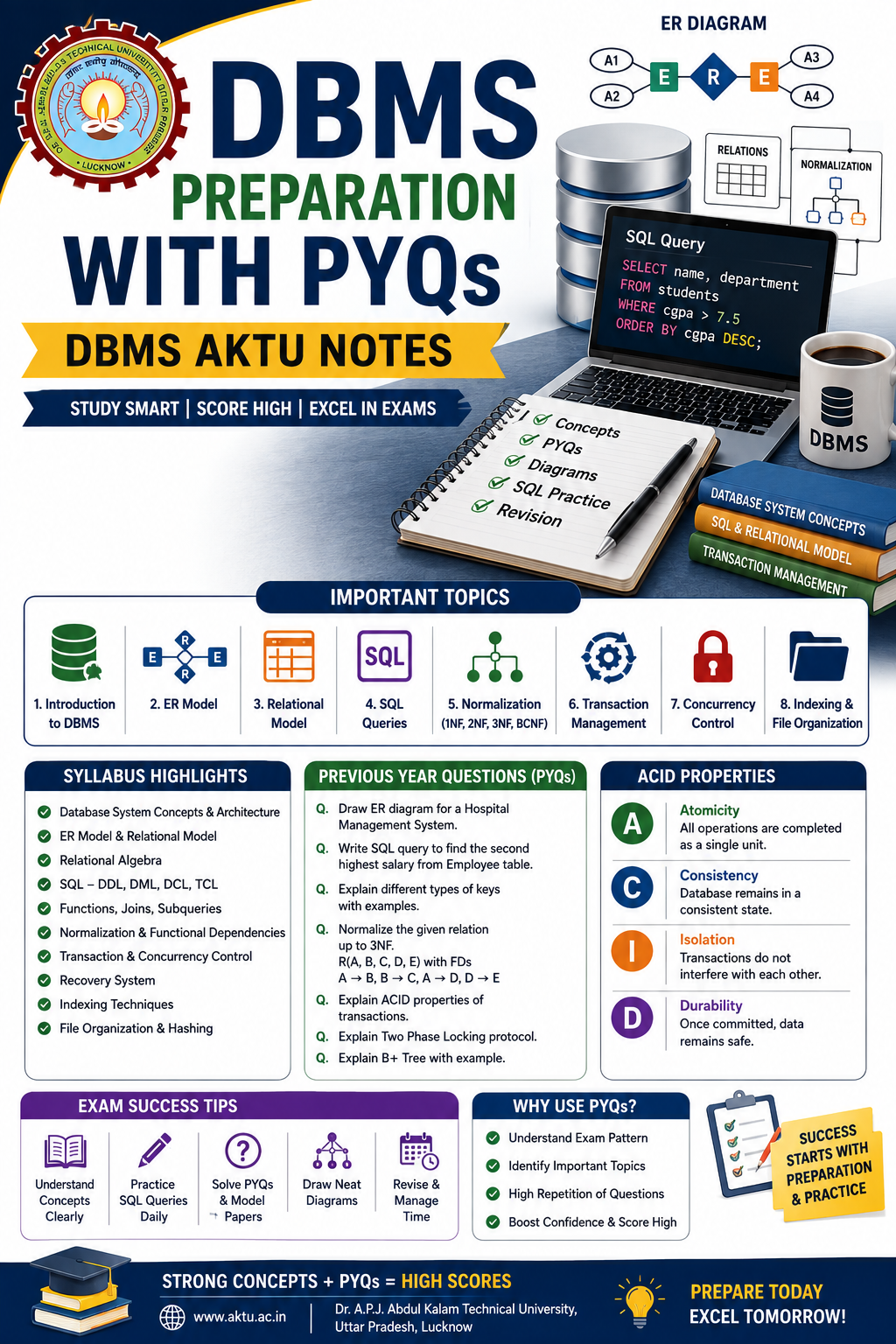
Database Management System (DBMS) is one of the core subjects in the AKTU Computer Science and Information Technology curriculum. Whether you’re preparing for semester examinations, placements, coding interviews, or higher studies, a strong understanding of databases is essential.
Using DBMS AKTU Notes along with Previous Year Questions (PYQs) is one of the most effective strategies to score well in examinations. PYQs help students understand question patterns, important topics, and frequently asked concepts.
In this guide, we’ll cover the most important DBMS topics, exam preparation tips, and high-scoring areas for AKTU students.
What is DBMS?
A Database Management System (DBMS) is software used to store, manage, retrieve, and organize data efficiently.
Examples include:
- MySQL
- Oracle
- PostgreSQL
- SQL Server
- MongoDB
DBMS allows users to access data securely while maintaining consistency and integrity.
Why is DBMS Important?
DBMS is widely used in:
- Banking Systems
- E-Commerce Platforms
- Hospital Management Systems
- Social Media Applications
- University Portals
- Mobile Applications
Learning DBMS helps students understand how large-scale applications store and manage data.
Most Important Topics for AKTU Exams
1. Introduction to DBMS
Students should understand:
- Database Concepts
- File System vs DBMS
- Advantages of DBMS
- Database Users
- Database Architecture
This chapter forms the foundation of the subject.
2. ER Model (Entity Relationship Model)
Highly important for AKTU exams.
Topics include:
- Entity
- Attributes
- Relationships
- Cardinality
- Participation Constraints
Common PYQ:
Draw an ER diagram for a Library Management System.
3. Relational Model
Key concepts:
- Relations
- Tuples
- Attributes
- Domains
- Keys
Important Types of Keys:
- Primary Key
- Foreign Key
- Candidate Key
- Alternate Key
- Composite Key
- Super Key
Questions related to keys appear almost every semester.
4. SQL Queries
One of the highest-scoring units in DBMS.
Important Commands:
DDL Commands
- CREATE
- ALTER
- DROP
- TRUNCATE
DML Commands
- INSERT
- UPDATE
- DELETE
DQL Commands
- SELECT
TCL Commands
- COMMIT
- ROLLBACK
Important SQL Topics:
- Joins
- Subqueries
- Aggregate Functions
- Group By
- Having Clause
- Nested Queries
5. Normalization
Normalization is frequently asked in AKTU examinations.
Important Forms:
- 1NF
- 2NF
- 3NF
- BCNF
Students should learn:
- Functional Dependency
- Partial Dependency
- Transitive Dependency
Typical PYQ:
Normalize the given relation up to 3NF.
6. Transaction Management
Important Concepts:
- Transaction States
- Serial Schedule
- Concurrent Schedule
- Deadlock
- Recovery
Remember ACID Properties:
- Atomicity
- Consistency
- Isolation
- Durability
ACID properties are among the most frequently repeated questions.
7. Concurrency Control
Topics include:
- Locking Mechanisms
- Two Phase Locking
- Timestamp Protocol
- Deadlock Handling
Often asked as long-answer questions.
8. Indexing and File Organization
Important Topics:
- Primary Index
- Secondary Index
- B-Tree
- B+ Tree
- Hashing
Students should practice diagrams and tree construction.
Most Repeated PYQs in AKTU
Unit 1
- Explain DBMS architecture.
- Difference between DBMS and File System.
- Advantages of DBMS.
Unit 2
- Draw ER Diagram.
- Explain relational algebra operations.
- Types of keys.
Unit 3
- Write SQL queries.
- Explain joins with examples.
- Aggregate functions in SQL.
Unit 4
- Explain normalization with examples.
- Convert relation into 3NF.
- Functional dependency problems.
Unit 5
- Explain ACID properties.
- Deadlock detection methods.
- Two Phase Locking Protocol.
- Transaction states.
How to Prepare DBMS Using PYQs
Step 1: Study Unit-Wise
Complete one unit at a time and solve related PYQs immediately.
Step 2: Create SQL Practice Notes
Maintain a separate notebook for:
- SQL Commands
- Join Queries
- Nested Queries
- Database Examples
Step 3: Focus on Diagrams
Practice:
- ER Diagrams
- Database Architecture
- B-Trees
- Transaction State Diagrams
Well-labeled diagrams fetch extra marks.
Step 4: Learn Definitions
Many short questions come directly from definitions.
Prepare definitions for:
- Database
- Schema
- Instance
- Normalization
- Transaction
- Deadlock
Step 5: Solve Previous 5 Years Papers
Benefits include:
- Understanding question trends
- Identifying repeated topics
- Better time management
- Improved confidence
High-Scoring Topics Before Exams
If your exam is near, focus on:
- SQL Queries
- Normalization
- ER Diagram
- Keys
- ACID Properties
- Transaction Management
- Relational Algebra
- DBMS Architecture
These topics contribute significantly to AKTU examination papers.
Career Benefits of DBMS
Strong DBMS concepts help in:
- Software Development
- Web Development
- Data Engineering
- Data Analytics
- Cloud Computing
- Backend Development
DBMS is also one of the most asked subjects during technical interviews and placement drives.
Conclusion
A good understanding of databases is essential for every Computer Science student. By combining structured DBMS AKTU Notes with Previous Year Questions, students can strengthen their concepts, improve problem-solving skills, and score higher in examinations.
Focus on SQL, normalization, transactions, ER diagrams, and database architecture to maximize your performance. Consistent revision and PYQ practice remain the most effective strategies for mastering DBMS and excelling in AKTU exams.