
Currently Empty: ₹0.00
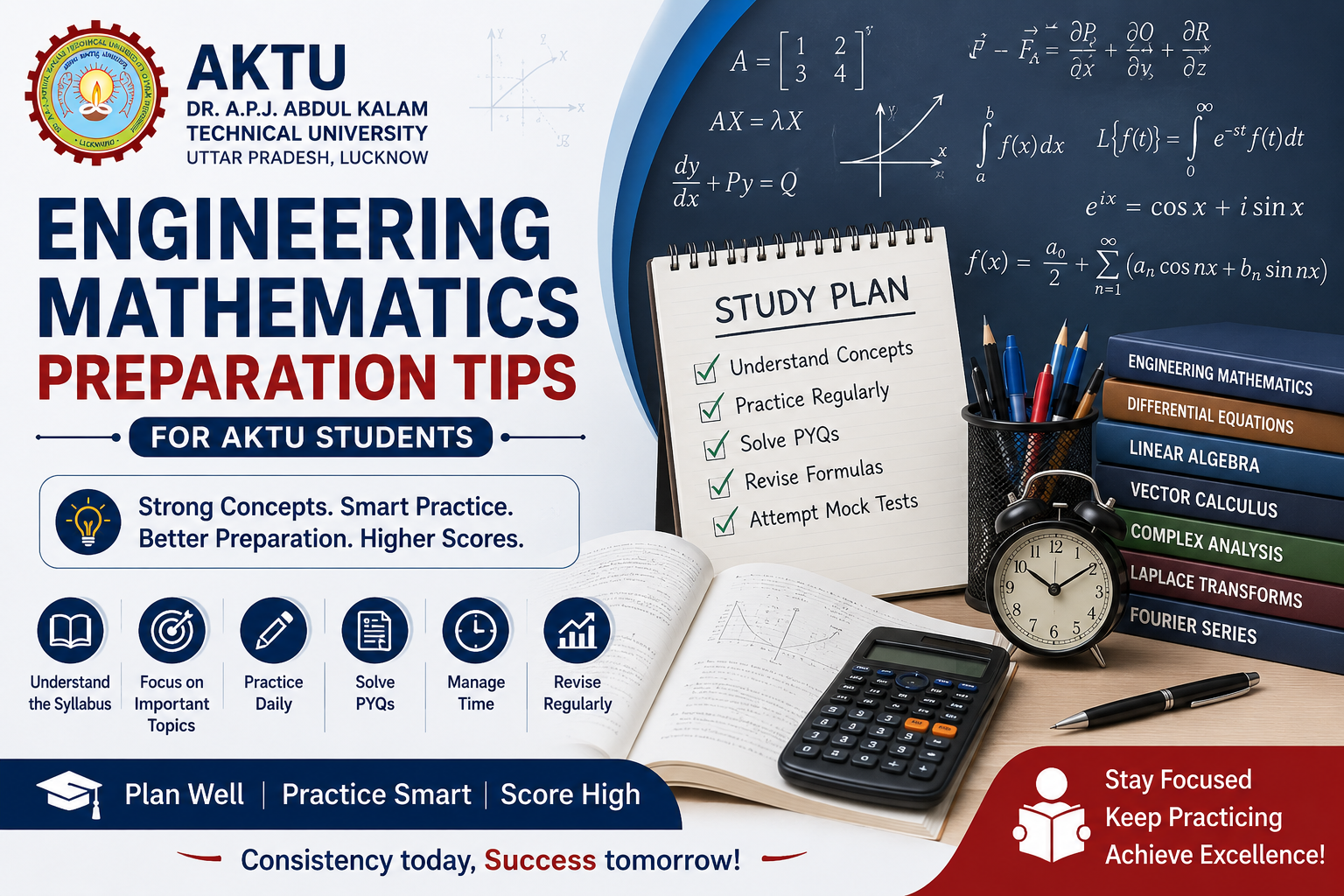
Engineering Mathematics is one of the most important subjects in the B.Tech curriculum at AKTU. It forms the foundation for various engineering subjects, including signal processing, machine learning, control systems, electronics, mechanics, and data analysis. Many students find mathematics challenging, but with the right strategy and consistent practice, it can become one of the highest-scoring subjects in the semester.
Whether you are preparing for Engineering Mathematics-I (BAS103) or Engineering Mathematics-II (BAS203), having a structured study plan can significantly improve your performance. AKTU’s mathematics syllabus covers topics such as matrices, calculus, vector calculus, differential equations, Laplace transforms, complex analysis, and Fourier series.
Why Engineering Mathematics is Important
Engineering Mathematics helps students:
- Develop analytical thinking
- Solve engineering problems efficiently
- Build a strong foundation for technical subjects
- Improve problem-solving skills
- Prepare for competitive exams and placements
Since many advanced engineering concepts are based on mathematical principles, mastering mathematics early can benefit your entire academic journey.
Understand the AKTU Syllabus First
Before starting preparation, carefully review the latest syllabus and identify all units and important topics.
Common AKTU Engineering Mathematics topics include:
Engineering Mathematics-I (BAS103)
- Matrices and Linear Algebra
- Eigenvalues and Eigenvectors
- Differential Calculus
- Multiple Integration
- Vector Calculus
Engineering Mathematics-II (BAS203)
- Ordinary Differential Equations
- Laplace Transform
- Sequence and Series
- Complex Variables
- Fourier Series
These topics are part of the current AKTU curriculum for first-year B.Tech students.
Effective Preparation Tips
1. Build Strong Fundamentals
Many Engineering Mathematics concepts are extensions of Class 11 and 12 mathematics.
Revise:
- Algebra
- Trigonometry
- Basic Calculus
- Coordinate Geometry
A strong foundation makes advanced topics easier to understand.
2. Create a Unit-Wise Study Plan
Divide the syllabus into manageable sections.
Example:
| Week | Topics |
|---|---|
| Week 1 | Matrices & Linear Algebra |
| Week 2 | Differential Calculus |
| Week 3 | Integration |
| Week 4 | Vector Calculus |
| Week 5 | Revision & Practice |
A structured plan helps maintain consistency.
3. Focus on Concepts Before Memorization
Avoid memorizing solutions without understanding the underlying concepts.
Instead:
- Learn formulas logically
- Understand derivations
- Practice different problem types
- Identify common patterns
Concept clarity improves problem-solving speed during exams.
4. Practice Daily
Mathematics is a skill-based subject.
Aim for:
- 15–20 problems daily
- Unit-wise exercises
- Numerical practice
- Mixed-topic revision sessions
Regular practice increases confidence and accuracy.
5. Solve Previous Year Question Papers
Previous Year Questions (PYQs) are one of the most effective preparation tools.
Benefits include:
- Understanding question patterns
- Identifying frequently asked topics
- Improving time management
- Building exam confidence
AKTU students often find recurring concepts and question styles across multiple examinations.
6. Prepare a Formula Notebook
Engineering Mathematics contains numerous formulas and theorems.
Maintain a dedicated notebook for:
- Important formulas
- Theorems
- Properties
- Shortcut techniques
Revise this notebook regularly before exams.
7. Prioritize High-Weightage Topics
Focus extra attention on topics that frequently appear in examinations.
Examples include:
- Eigenvalues and Eigenvectors
- Laplace Transform
- Differential Equations
- Fourier Series
- Vector Calculus
Mastering these topics can significantly improve your score.
8. Use Visual Learning Resources
Many students learn mathematics more effectively through visual explanations.
Helpful resources include:
- Video lectures
- Topic-wise tutorials
- Graphical demonstrations
- Step-by-step problem-solving sessions
These can improve conceptual understanding.
9. Practice Time-Bound Tests
Before examinations:
- Solve full-length papers
- Set time limits
- Simulate exam conditions
This improves speed and reduces exam anxiety.
10. Revise Regularly
Do not wait until the last week.
Follow:
- Weekly revision
- Monthly revision
- Formula review
- PYQ revision
Consistent revision strengthens long-term retention.
Common Mistakes Students Should Avoid
Skipping Fundamentals
Weak basics often create difficulties in advanced topics.
Ignoring Practice
Reading theory alone is insufficient for mathematics.
Studying Only Before Exams
Last-minute preparation increases stress and reduces performance.
Avoiding Difficult Topics
Address challenging topics early rather than postponing them.
Recommended Study Resources
Students can use:
- AKTU syllabus and curriculum documents
- Standard Engineering Mathematics textbooks
- Previous Year Question Papers
- Unit-wise notes
- Online lectures and tutorials
Several AKTU-focused study resources and syllabus references are available for BAS103 and BAS203 subjects.
Exam-Day Strategy
Before the Exam
- Revise formulas
- Solve a few important problems
- Stay calm and confident
During the Exam
- Read questions carefully
- Attempt easy questions first
- Show complete steps
- Manage time efficiently
Mathematics often awards marks for proper methodology even if the final answer is incorrect.
Conclusion
Scoring well in Engineering Mathematics AKTU requires a combination of conceptual understanding, regular practice, and strategic preparation. By following a structured study plan, solving previous year papers, revising formulas, and focusing on high-weightage topics, students can improve both confidence and performance.
Remember, Engineering Mathematics is not about memorization—it’s about understanding patterns, applying concepts, and practicing consistently. With dedication and smart preparation, it can become one of your strongest subjects.