Currently Empty: ₹0.00
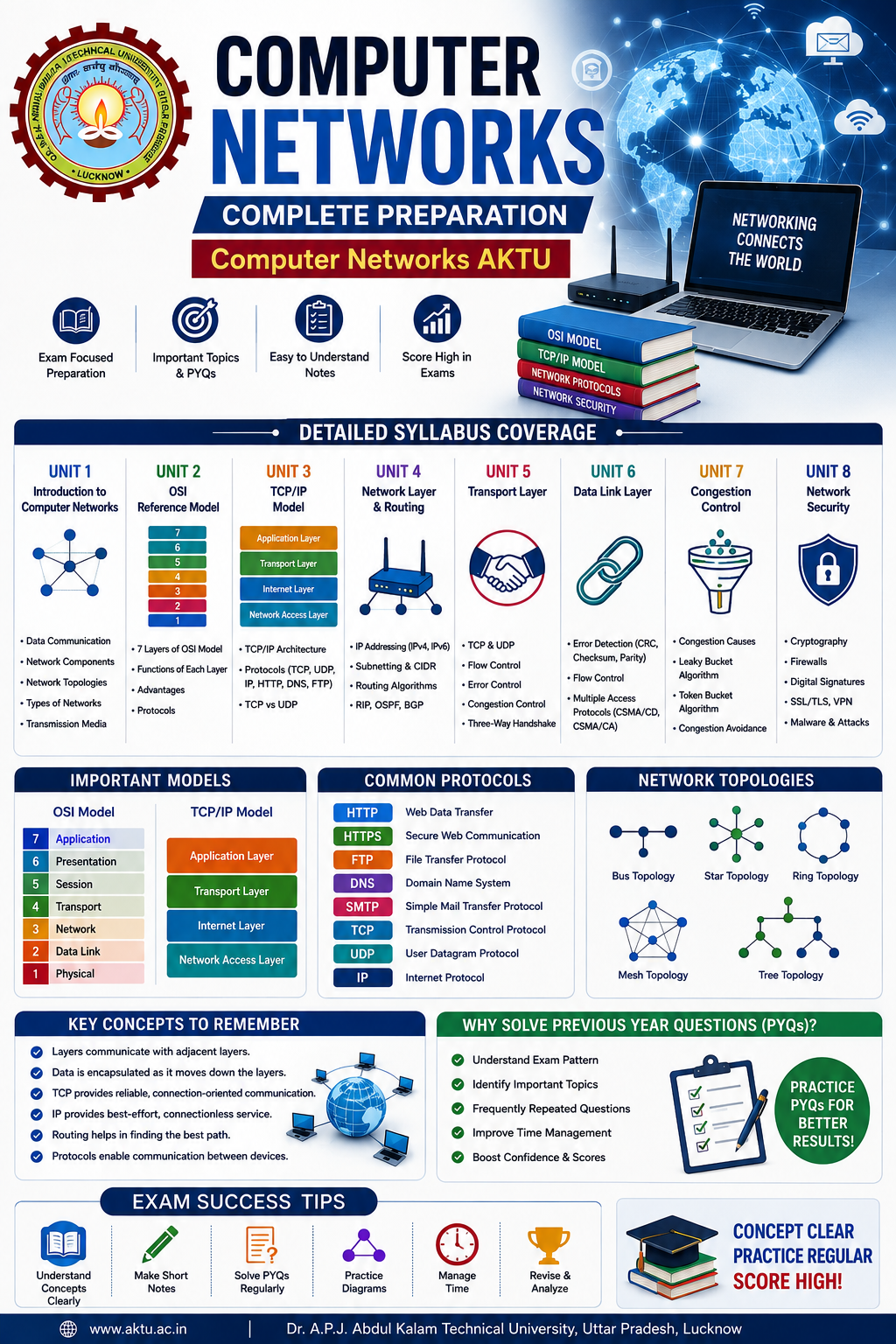
Computer Networks is one of the most important subjects for B.Tech Computer Science and Information Technology students. Whether you’re preparing for AKTU semester exams, placements, GATE, or technical interviews, a strong understanding of networking concepts is essential.
Using structured Computer Networks AKTU notes and focusing on important topics can help students score high marks while building practical knowledge used in the real world.
This guide covers all major units, important concepts, and exam preparation strategies for AKTU students.
What is a Computer Network?
A Computer Network is a collection of interconnected devices that communicate and share resources through communication channels.
Examples include:
- Internet
- Wi-Fi Networks
- LAN Networks
- Mobile Networks
- Cloud Networks
Computer networks enable data sharing, communication, and resource utilization across devices.
Why Study Computer Networks?
Computer Networks form the backbone of modern technology.
Benefits include:
- Understanding Internet Communication
- Network Troubleshooting Skills
- Better Placement Preparation
- Cloud Computing Knowledge
- Cybersecurity Foundation
- Software Development Support
Networking concepts are frequently asked in technical interviews and competitive examinations.
Important Units for AKTU Exams
Unit 1: Introduction to Computer Networks
Topics include:
- Data Communication
- Network Components
- Network Topologies
- Network Types
- Transmission Media
Network Types
- LAN (Local Area Network)
- MAN (Metropolitan Area Network)
- WAN (Wide Area Network)
Common Topologies
- Bus
- Star
- Ring
- Mesh
- Tree
Frequently Asked Question:
Explain different network topologies with advantages and disadvantages.
Unit 2: OSI Reference Model
One of the most important topics in Computer Networks AKTU.
OSI Layers
- Physical Layer
- Data Link Layer
- Network Layer
- Transport Layer
- Session Layer
- Presentation Layer
- Application Layer
Students should learn:
- Functions of each layer
- Layer-wise protocols
- Advantages of OSI Model
Common Exam Question
Explain the OSI Reference Model with neat diagram.
Unit 3: TCP/IP Model
The TCP/IP model is the practical implementation used on the Internet.
Layers
- Network Access Layer
- Internet Layer
- Transport Layer
- Application Layer
Important Protocols
- TCP
- UDP
- IP
- HTTP
- HTTPS
- FTP
- SMTP
- DNS
Difference Between TCP and UDP
| TCP | UDP |
|---|---|
| Connection Oriented | Connectionless |
| Reliable | Less Reliable |
| Slower | Faster |
| Error Checking | Minimal Error Handling |
This comparison is frequently asked in exams.
Unit 4: Network Layer and Routing
Important concepts:
Routing Algorithms
- Distance Vector Routing
- Link State Routing
Routing Protocols
- RIP
- OSPF
- BGP
IP Addressing
Students must understand:
- IPv4
- IPv6
- Subnetting
- Classful Addressing
- CIDR
Common Questions
- Explain IPv4 addressing.
- Compare IPv4 and IPv6.
- Explain routing algorithms.
Unit 5: Transport Layer
The transport layer provides reliable communication.
Key Topics
- TCP
- UDP
- Flow Control
- Error Control
- Sliding Window Protocol
- Congestion Control
Important TCP Features
- Three-Way Handshake
- Reliable Transmission
- Connection Establishment
These concepts often appear in long-answer questions.
Unit 6: Data Link Layer
Important topics include:
Error Detection
- Parity Check
- CRC
- Checksum
Flow Control
- Stop and Wait Protocol
- Sliding Window Protocol
Multiple Access Protocols
- CSMA/CD
- CSMA/CA
Students should practice protocol diagrams.
Unit 7: Congestion Control
Network congestion occurs when traffic exceeds network capacity.
Important techniques:
- Leaky Bucket Algorithm
- Token Bucket Algorithm
- Congestion Avoidance
- Congestion Detection
Frequently asked in AKTU examinations.
Unit 8: Network Security
Highly important for semester exams.
Topics Include
- Cryptography
- Firewalls
- Digital Signatures
- SSL/TLS
- VPN
- Malware
- Cyber Attacks
Common Questions
- Explain Firewall.
- What is Cryptography?
- Explain Digital Signature.
Most Repeated AKTU Questions
Unit 1
- Explain Network Topologies.
- Types of Networks.
Unit 2
- Explain OSI Model.
- Functions of Network Layer.
Unit 3
- Compare TCP and UDP.
- Explain TCP/IP Architecture.
Unit 4
- IPv4 vs IPv6.
- Routing Algorithms.
Unit 5
- Three-Way Handshake.
- Congestion Control.
Unit 6
- Error Detection Methods.
- Sliding Window Protocol.
Unit 7
- Leaky Bucket Algorithm.
- Token Bucket Algorithm.
Unit 8
- Firewall.
- Digital Signature.
- SSL Protocol.
Exam Preparation Strategy
Step 1: Master OSI & TCP/IP Models
These chapters form the foundation of networking and appear regularly in exams.
Step 2: Practice Diagrams
Draw:
- OSI Model
- TCP/IP Architecture
- Network Topologies
- Routing Diagrams
- Three-Way Handshake
Neat diagrams improve presentation and marks.
Step 3: Learn Protocols
Prepare notes for:
- HTTP
- HTTPS
- FTP
- DNS
- SMTP
- TCP
- UDP
Step 4: Solve PYQs
Previous Year Questions help identify:
- Repeated concepts
- Important units
- Question patterns
At least 5 years of AKTU papers should be practiced.
Step 5: Prepare Short Notes
Create revision notes for:
- OSI Layers
- TCP/IP Protocols
- Routing Algorithms
- Network Security
- Error Detection Methods
These are highly useful during last-minute revision.
High-Scoring Topics Before Exam
If you have limited preparation time, focus on:
- OSI Model
- TCP/IP Model
- TCP vs UDP
- Routing Algorithms
- IPv4 and IPv6
- Three-Way Handshake
- Congestion Control
- Network Security
- Error Detection Techniques
- Network Topologies
These topics cover a large portion of AKTU exam papers.
Career Benefits of Learning Computer Networks
Computer Networks is essential for careers in:
- Network Engineering
- Cybersecurity
- Cloud Computing
- System Administration
- DevOps
- Software Engineering
- Ethical Hacking
- IT Infrastructure
Networking knowledge is highly valued by employers across the technology industry.
Conclusion
Computer Networks is a foundational subject for every Computer Science student. By studying Computer Networks AKTU notes systematically, understanding protocols, practicing diagrams, and solving previous year questions, students can score excellent marks and build strong technical skills.
Focus on OSI, TCP/IP, Routing, Congestion Control, and Network Security to maximize your exam performance and strengthen your preparation for placements and future career opportunities.