Currently Empty: ₹0.00
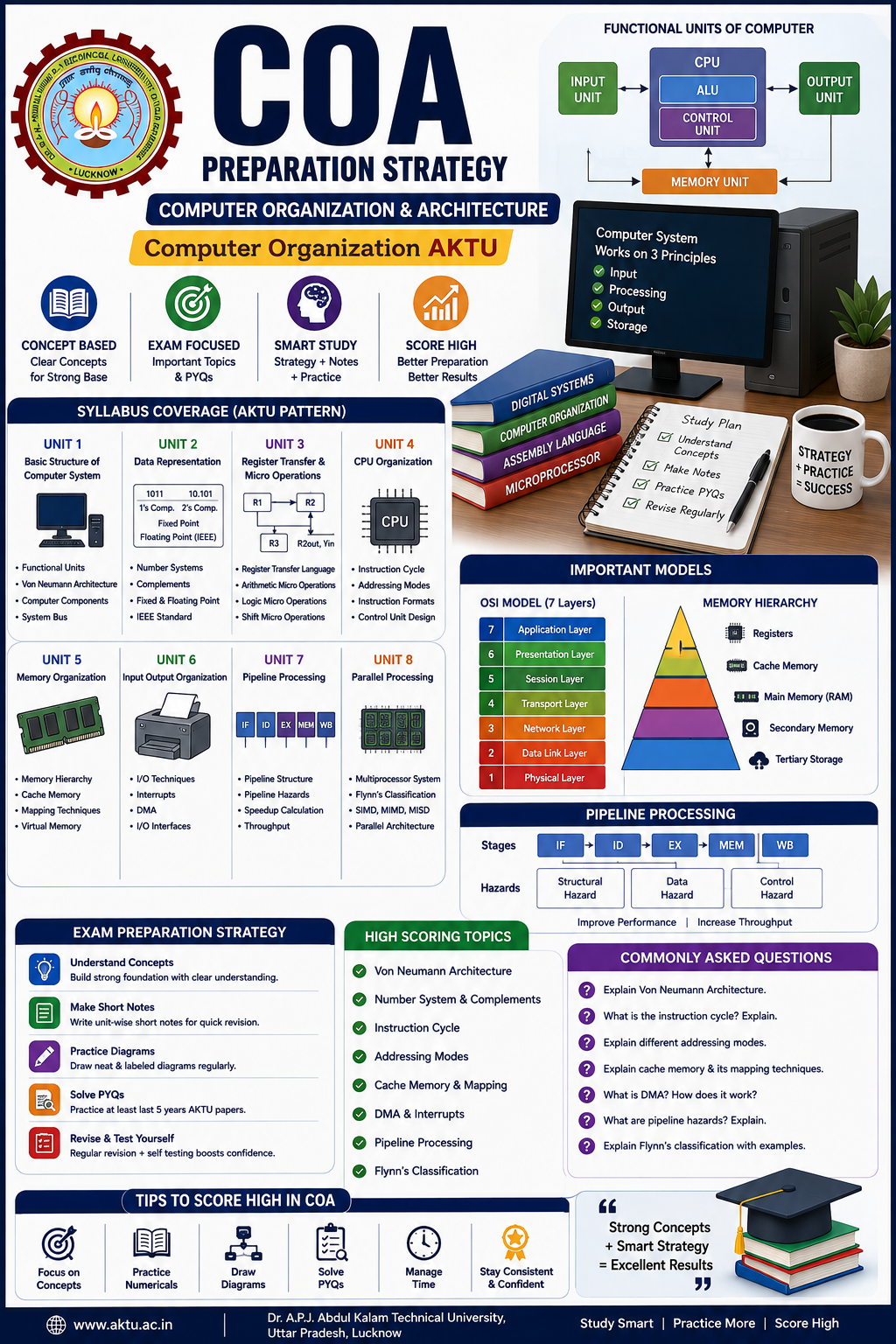
Computer Organization and Architecture (COA) is one of the most important subjects for B.Tech Computer Science and Information Technology students. The subject helps students understand how computer systems actually work internally, from processors and memory to input/output devices and instruction execution.
For AKTU students, a strong understanding of Computer Organization AKTU concepts is essential not only for semester examinations but also for GATE preparation, technical interviews, and careers in software and hardware engineering.
This guide provides a complete preparation strategy, important topics, and exam-focused tips to help students score better and understand COA effectively.
What is Computer Organization and Architecture?
Computer Organization and Architecture deals with the internal structure and operational behavior of computer systems.
It focuses on:
- CPU Design
- Memory Systems
- Instruction Execution
- Input/Output Organization
- Data Representation
- Pipelining
- Processor Performance
The subject explains how hardware components interact to execute programs efficiently.
Why COA is Important?
COA forms the foundation for advanced subjects such as:
- Operating Systems
- Computer Networks
- Embedded Systems
- Compiler Design
- Microprocessors
- System Programming
It is also frequently asked during technical interviews and competitive examinations.
Important Units for AKTU Exams
Unit 1: Basic Structure of Computer Systems
Topics include:
- Functional Units of Computer
- Von Neumann Architecture
- Stored Program Concept
- Computer Components
- System Bus
Frequently Asked Questions
- Explain Von Neumann Architecture.
- Describe functional units of a computer.
Unit 2: Data Representation
This unit is highly scoring.
Topics include:
Number Systems
- Binary
- Decimal
- Octal
- Hexadecimal
Complements
- 1’s Complement
- 2’s Complement
Data Representation
- Fixed Point Representation
- Floating Point Representation
- IEEE Standards
Common Questions
- Explain floating point representation.
- Convert decimal to binary and vice versa.
Unit 3: Register Transfer and Micro Operations
Important topics:
- Register Transfer Language (RTL)
- Arithmetic Operations
- Logic Operations
- Shift Operations
- Bus Organization
Students should practice diagrams and examples.
Unit 4: CPU Organization
One of the most important units.
Topics include:
Instruction Cycle
- Fetch Cycle
- Decode Cycle
- Execute Cycle
Addressing Modes
- Immediate
- Direct
- Indirect
- Register
- Indexed
Instruction Formats
Questions from instruction cycles are frequently repeated in AKTU exams.
Unit 5: Memory Organization
Memory organization is a favorite exam topic.
Memory Hierarchy
- Registers
- Cache Memory
- Main Memory
- Secondary Memory
Cache Memory
Topics include:
- Mapping Techniques
- Cache Organization
- Hit Ratio
- Miss Ratio
Virtual Memory
Students must understand paging and memory management concepts.
Unit 6: Input Output Organization
Important concepts:
I/O Techniques
- Programmed I/O
- Interrupt Driven I/O
- DMA
Interrupts
- Hardware Interrupts
- Software Interrupts
- Interrupt Cycle
Common Questions
- Explain DMA.
- Compare Interrupt Driven I/O and Programmed I/O.
Unit 7: Pipeline Processing
This unit is highly important for semester examinations.
Topics include:
Pipelining Concepts
- Pipeline Structure
- Pipeline Hazards
- Speedup Calculation
- Throughput
Hazards
- Data Hazard
- Structural Hazard
- Control Hazard
Students should practice numerical problems related to pipeline performance.
Unit 8: Parallel Processing
Topics include:
- Multiprocessor Systems
- Flynn’s Classification
- Parallel Architecture
- SIMD
- MIMD
This unit is often asked in long-answer questions.
Most Repeated AKTU Questions
Unit 1
- Explain Von Neumann Architecture.
- Functional units of computer system.
Unit 2
- Floating point representation.
- Number system conversion.
Unit 3
- Register transfer language.
- Micro operations.
Unit 4
- Instruction cycle.
- Addressing modes.
Unit 5
- Cache memory.
- Memory hierarchy.
- Virtual memory.
Unit 6
- DMA.
- Interrupt mechanism.
Unit 7
- Pipelining.
- Pipeline hazards.
Unit 8
- Flynn’s classification.
- Parallel processing architecture.
How to Prepare COA Effectively
Step 1: Understand Concepts First
COA is concept-based rather than memorization-based.
Focus on understanding:
- CPU functioning
- Memory operations
- Instruction execution
rather than rote learning.
Step 2: Draw Diagrams Regularly
Practice:
- Von Neumann Architecture
- Memory Hierarchy
- Instruction Cycle
- Pipeline Architecture
- DMA Controller
Diagrams help secure extra marks in AKTU examinations.
Step 3: Create Short Notes
Prepare quick revision notes for:
- Addressing Modes
- Memory Types
- Pipeline Hazards
- Cache Mapping
- Flynn’s Classification
These are useful during final revision.
Step 4: Practice Numerical Problems
Focus on:
- Cache Memory Problems
- Pipeline Speedup Calculations
- Number System Conversions
Numerical questions often appear in semester papers.
Step 5: Solve PYQs
Previous Year Questions help identify:
- Frequently repeated concepts
- High-weightage topics
- Important units
Practicing the last 5 years’ papers significantly improves preparation.
High-Scoring Topics Before Exams
If you have limited time, focus on:
- Von Neumann Architecture
- Number System Conversion
- Instruction Cycle
- Addressing Modes
- Memory Hierarchy
- Cache Memory
- DMA
- Interrupts
- Pipelining
- Flynn’s Classification
These topics cover a major portion of AKTU examination papers.
Career Benefits of Learning COA
Computer Organization knowledge is useful for careers in:
- Software Development
- System Programming
- Embedded Systems
- Computer Hardware
- Cybersecurity
- Cloud Computing
- Processor Design
- Operating Systems Development
Strong COA concepts also improve coding and debugging skills.
Conclusion
Computer Organization and Architecture is one of the core subjects in Computer Science Engineering. By studying Computer Organization AKTU notes systematically, understanding architecture concepts, practicing diagrams, and solving previous year questions, students can score excellent marks and strengthen their technical foundation.
Focus on CPU organization, memory hierarchy, cache memory, DMA, and pipelining to maximize your exam performance and build a strong understanding of computer systems.