Currently Empty: ₹0.00
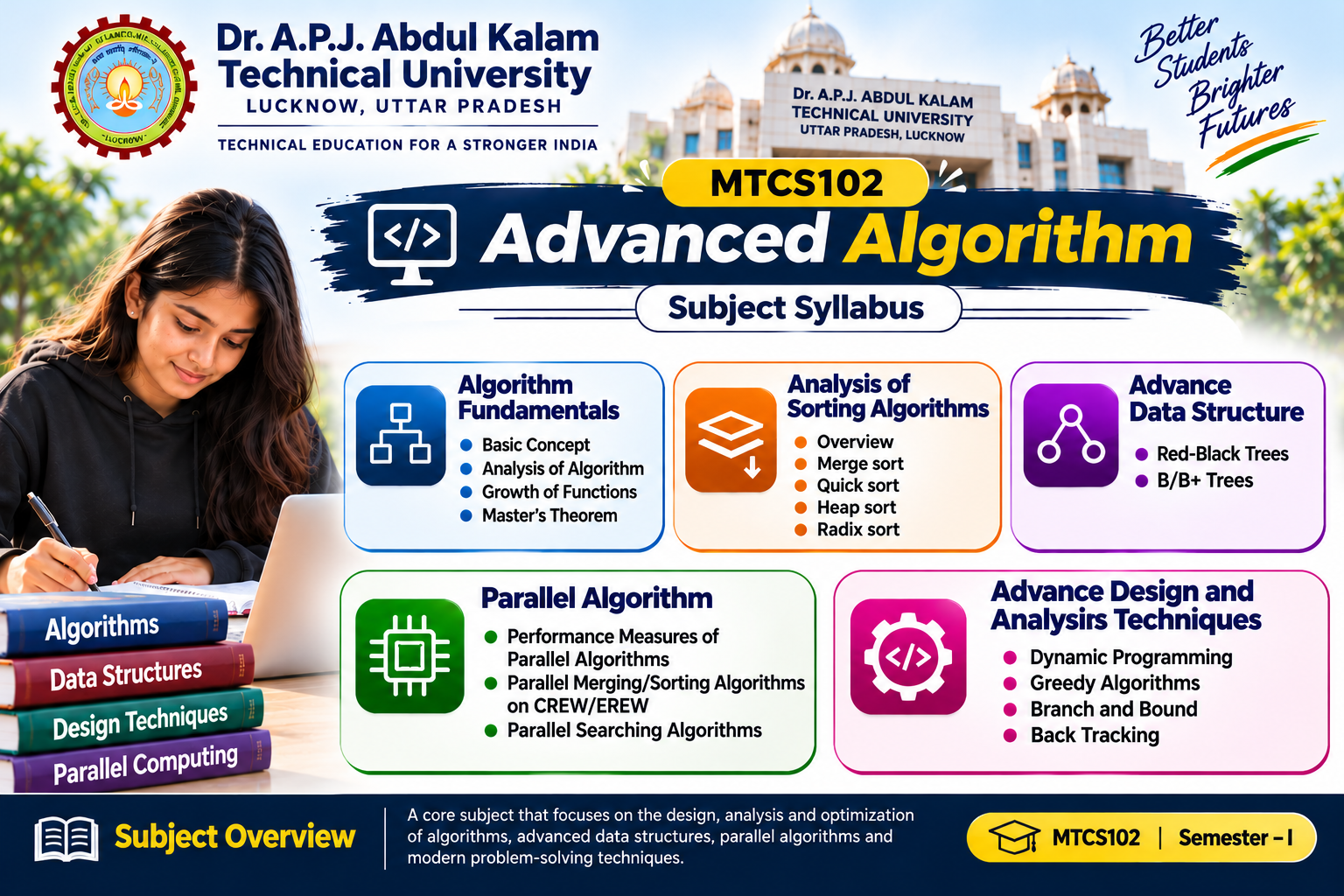
The Department of Computer Science & Engineering offers Advanced Algorithm (MTCS102) as part of the Semester I academic curriculum. This subject focuses on algorithm design, performance analysis, advanced data structures, parallel computing, and problem-solving techniques.
Advanced Algorithm helps students understand how complex computational problems can be solved efficiently through different algorithmic approaches and optimization techniques.
Subject Details
- Department: Computer Science & Engineering
- Subject Name: Advanced Algorithm
- Subject Code: MTCS102
- Semester: I
- Faculty: Mr. Rahul Dubey
Complete Unit-Wise Syllabus of Advanced Algorithm (MTCS102)
The Advanced Algorithm syllabus covers important concepts related to algorithm fundamentals, sorting techniques, advanced data structures, parallel algorithms, and advanced design and analysis techniques.
1. Algorithm Fundamentals
This section introduces the basic principles of algorithms and their performance analysis. Students learn how algorithms are designed, analyzed, and evaluated based on their efficiency.
Topics Covered:
- Basic Concept
- Analysis of Algorithm
- Growth of Functions
- Master’s Theorem
These concepts help students understand algorithm complexity and evaluate the efficiency of different problem-solving approaches.
2. Analysis of Sorting Algorithms
Sorting algorithms are used to arrange data in a particular order. This section focuses on different sorting techniques and their analysis.
Topics Covered:
- Overview of Sorting Algorithms
- Merge Sort
- Quick Sort
- Heap Sort
- Radix Sort
Students explore different sorting approaches and understand how these algorithms organize data efficiently.
3. Advance Data Structure
This section introduces advanced data structures used for efficient data organization, searching, and management.
Topics Covered:
- Red-Black Trees
- B/B+ Trees
Students learn about tree-based data structures and their role in managing large amounts of information efficiently.
4. Parallel Algorithm
Parallel algorithms focus on performing computational tasks simultaneously using multiple processing resources. This section introduces the performance and implementation of parallel computing techniques.
Topics Covered:
- Performance Measures of Parallel Algorithms
- Parallel Merging/Sorting Algorithms on CREW/EREW
- Parallel Searching Algorithms
These concepts help students understand parallel processing, computational performance, and efficient execution of algorithms.
5. Advance Design and Analysis Techniques
This section covers different algorithm design strategies used to solve complex computational problems.
Topics Covered:
- Dynamic Programming
- Greedy Algorithms
- Branch and Bound
- Back Tracking
Students learn different approaches to designing solutions, optimizing computational tasks, and solving complex problems.
6. Graph Algorithm
Graph algorithms are used to solve problems involving interconnected nodes and relationships. They are widely applied in networks, routing, and connectivity problems.
Topics Covered:
- DFS (Depth First Search)
- BFS (Breadth First Search)
Students understand graph traversal techniques and how they are used to explore graph structures.
7. NP Complete Problem
This topic introduces an important area of computational complexity theory. Students explore NP-complete problems and their significance in understanding computationally difficult problems.
Recommended Reference Books
Students can refer to the following books for detailed explanations and a better understanding of Advanced Algorithm concepts.
- Cormen, Rivest, Leiserson – Algorithms, PHI.
- Basse – Computer Algorithms: Introduction to Design & Analysis, Addison Wesley.
- Horowitz, Sahani and Rajasekaran – Fundamental of Computer Algorithms, Universities Press.
Importance of Studying Advanced Algorithm
Advanced Algorithm is an important subject for developing strong computational and analytical skills.
Some key learning benefits include:
- Understanding algorithm design and analysis.
- Learning different sorting and searching techniques.
- Developing knowledge of advanced data structures.
- Understanding parallel computing approaches.
- Improving logical and analytical problem-solving skills.
- Exploring computational complexity and optimization techniques.
Applications of Advanced Algorithms
The concepts covered in this subject are useful in several areas of computer science, including:
- Software and application development.
- Database searching and optimization.
- Network routing and graph processing.
- Data organization and processing.
- Parallel and distributed computing.
- Computational problem-solving.
Download Complete Advanced Algorithm Syllabus PDF
Students can download the complete Advanced Algorithm (MTCS102) syllabus PDF to access all prescribed topics and recommended reference books in one place.
The complete syllabus PDF is attached here for students to download, save, and use during their academic preparation.
Conclusion
Advanced Algorithm (MTCS102) provides students with knowledge of algorithm fundamentals, sorting techniques, advanced data structures, parallel algorithms, graph algorithms, and computational complexity.
Studying these topics helps students develop efficient problem-solving approaches and build a strong foundation for advanced computer science concepts and practical applications.