Currently Empty: ₹0.00
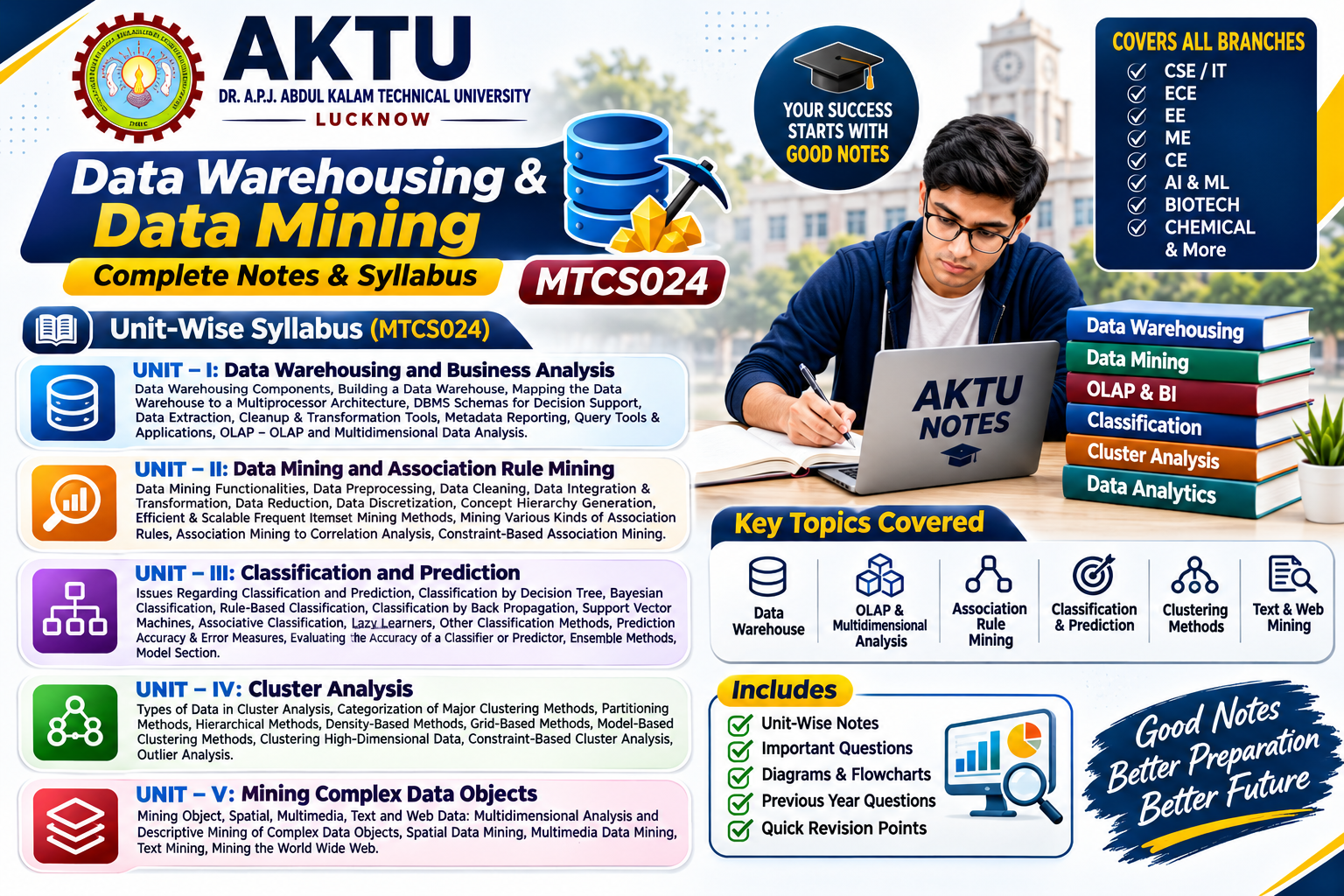
The Department of Computer Science & Engineering introduces Data Warehousing & Data Mining (MTCS024) as part of the academic curriculum for Semester I. This subject focuses on data storage, data analysis, data preprocessing, pattern discovery, classification, clustering, and knowledge extraction from large datasets.
Data Warehousing and Data Mining are important areas of computer science that help organizations manage large volumes of information and discover meaningful insights for better decision-making.
Subject Details
- Department: Computer Science & Engineering
- Subject Name: Data Warehousing & Data Mining
- Subject Code: MTCS024
- Semester: I
- Faculty: Dr. Vineet Agarwal
Complete Unit-Wise Syllabus of Data Warehousing & Data Mining (MTCS024)
The syllabus is divided into five units covering data warehousing, data mining techniques, classification, prediction, clustering, and mining complex data objects.
UNIT I: Data Warehousing and Business Analysis
This unit introduces the fundamentals of data warehousing and business analysis. Students learn how data is collected, stored, transformed, and analyzed to support business intelligence and decision-making.
Topics Covered:
1. Data Warehousing and Business Analysis
- Data Warehousing Components
- Building a Data Warehouse
- Mapping the Data Warehouse to a Multiprocessor Architecture
- DBMS Schemas for Decision Support
2. Data Extraction and Transformation
- Data Extraction
- Cleanup and Transformation Tools
- Metadata Reporting
- Query Tools and Applications
3. Online Analytical Processing (OLAP)
- Online Analytical Processing (OLAP)
- Multidimensional Data Analysis
Students will understand the architecture of data warehouses, data preparation processes, and analytical techniques used to support business decisions.
UNIT II: Data Mining and Association Rule Mining
This unit focuses on data mining functionalities, preprocessing techniques, and methods used to discover meaningful patterns and relationships in large datasets.
Topics Covered:
1. Data Mining
- Data Mining Functionalities
- Data Preprocessing
- Data Cleaning
- Data Integration and Transformation
- Data Reduction
- Data Discretization
- Concept Hierarchy Generation
2. Association Rule Mining
- Efficient and Scalable Frequent Itemset Mining Methods
- Mining Various Kinds of Association Rules
- Association Mining to Correlation Analysis
- Constraint-Based Association Mining
This unit helps students understand how raw data is processed, organized, and analyzed to discover useful patterns and associations.
UNIT III: Classification and Prediction
Classification and prediction are important data mining techniques used to analyze existing data and identify patterns for making future decisions.
This unit covers different classification methods, prediction techniques, and evaluation approaches.
Topics Covered:
- Issues Regarding Classification and Prediction
- Classification by Decision Tree Introduction
- Bayesian Classification
- Rule-Based Classification
- Classification by Back Propagation
- Support Vector Machines
- Associative Classification
- Lazy Learners
- Other Classification Methods
- Prediction Accuracy and Error Measures
- Evaluating the Accuracy of a Classifier or Predictor
- Ensemble Methods
- Model Section
Students will learn how different classification techniques work and how prediction models are evaluated based on accuracy and error measurements.
UNIT IV: Cluster Analysis
Cluster Analysis focuses on grouping similar data objects into clusters based on their characteristics and relationships.
This unit introduces different clustering techniques and methods used to analyze complex and high-dimensional datasets.
Topics Covered:
- Types of Data in Cluster Analysis
- Categorization of Major Clustering Methods
- Partitioning Methods
- Hierarchical Methods
- Density-Based Methods
- Grid-Based Methods
- Model-Based Clustering Methods
- Clustering High-Dimensional Data
- Constraint-Based Cluster Analysis
- Outlier Analysis
Students will understand how clustering algorithms organize data into meaningful groups and identify unusual or outlier data points.
UNIT V: Mining Complex Data Objects
This unit explores advanced data mining techniques used to analyze different types of complex data, including spatial, multimedia, text, and web data.
It introduces methods for extracting useful information from different forms of digital information.
Topics Covered:
1. Mining Objects
- Spatial Data
- Multimedia Data
- Text Data
- Web Data
2. Advanced Data Mining Techniques
- Multidimensional Analysis and Descriptive Mining of Complex Data Objects
- Spatial Data Mining
- Multimedia Data Mining
- Text Mining
- Mining the World Wide Web
Students will understand how data mining techniques are applied to complex information sources and how useful knowledge can be extracted from spatial, multimedia, textual, and web-based data.
Recommended Reference Books for Data Warehousing & Data Mining (MTCS024)
Students can refer to the following books for detailed explanations, theoretical concepts, and practical understanding of data warehousing and data mining.
- Data Mining: Concepts and Techniques – Jiawei Han and Micheline Kamber, Second Edition, Elsevier.
- Data Warehousing, Data Mining & OLAP – Alex Berson and Stephen J. Smith, Tata McGraw-Hill Edition, Tenth Reprint 2007.
- Introduction to Data Mining with Case Studies – G. K. Gupta, Easter Economy Edition, Prentice Hall of India, 2006.
- Introduction to Data Mining – Pang-Ning Tan, Michael Steinbach and Vipin Kumar, Pearson Education, 2007.
- Insight into Data Mining Theory and Practice – Soman K.P., Shyam Diwakar and V. Ajay, Easter Economy Edition, Prentice Hall of India, 2006.
- Data Mining Methods and Models – Daniel T. Larose, Wiley-Interscience, 2006.
Importance of Studying Data Warehousing & Data Mining
Data Warehousing and Data Mining play an important role in modern data-driven industries. These technologies help organizations store large datasets, identify patterns, analyze business information, and make informed decisions.
Some important learning outcomes include:
- Understanding data warehouse architecture and components.
- Learning data extraction, cleaning, and transformation techniques.
- Exploring OLAP and multidimensional data analysis.
- Understanding association rule mining and data preprocessing.
- Learning classification and prediction techniques.
- Understanding different clustering methods.
- Exploring spatial, multimedia, text, and web data mining.
Applications of Data Warehousing & Data Mining
The concepts covered in this subject are widely used across different industries and technology platforms.
Some common applications include:
- Business Intelligence and Analytics
- Banking and Financial Data Analysis
- Customer Behaviour Analysis
- Retail and Market Basket Analysis
- Healthcare Data Analysis
- Fraud Detection
- Recommendation Systems
- Web and Text Data Analysis
- Big Data Processing
Download Complete Data Warehousing & Data Mining Syllabus PDF
Students can download the complete Data Warehousing & Data Mining (MTCS024) syllabus PDF to access all five units, detailed topics, subtopics, and recommended reference books.
The complete syllabus PDF is attached here for easy access, academic preparation, and future reference.
Conclusion
Data Warehousing & Data Mining (MTCS024) provides students with a comprehensive understanding of data storage, processing, analysis, and knowledge discovery techniques.
By studying all five units, students gain knowledge of data warehousing, preprocessing, association rule mining, classification, prediction, clustering, and complex data mining. These concepts help build a strong foundation for advanced studies in data science, business intelligence, and data analytics.