Currently Empty: ₹0.00
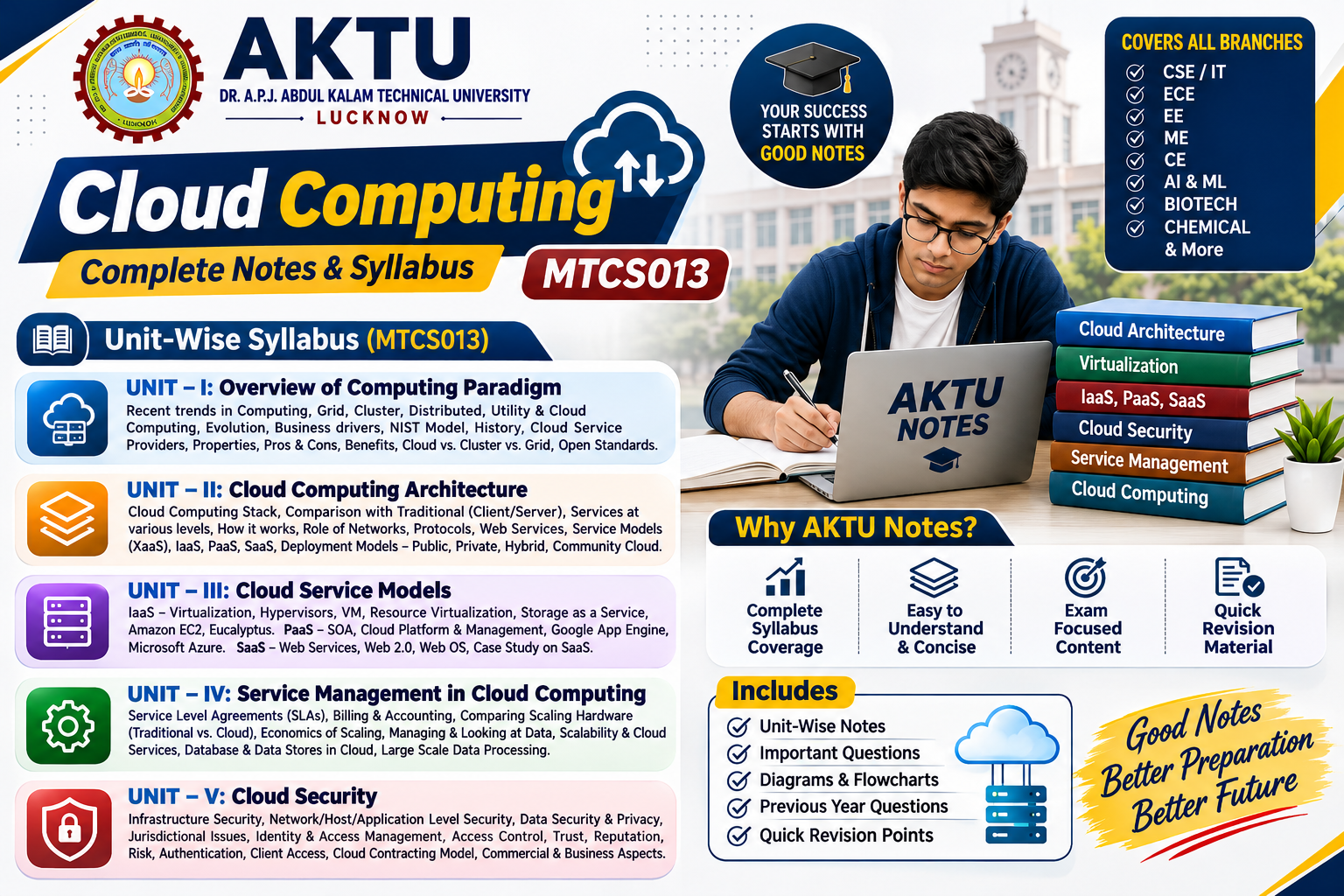
The Department of Computer Science & Engineering introduces Cloud Computing (MTCS013) as part of the Semester I academic curriculum. This subject provides students with an understanding of cloud computing technologies, architecture, infrastructure, service models, virtualization, cloud security, and service management.
Cloud Computing is an important area of modern computer science that enables users and organizations to access computing resources, storage, applications, and services over the internet.
Subject Details
- Department: Computer Science & Engineering
- Subject Name: Cloud Computing
- Subject Code: MTCS013
- Semester: I
- Faculty: Dr. Vineet Agarwal
Complete Unit-Wise Syllabus of Cloud Computing (MTCS013)
The Cloud Computing syllabus is divided into five units, covering the fundamentals of cloud computing, cloud architecture, service models, cloud management, and security.
UNIT I: Overview of Computing Paradigm & Introduction to Cloud Computing
This unit introduces students to modern computing paradigms and the fundamental concepts of cloud computing. It explains the evolution of computing technologies, cloud service providers, and the benefits of adopting cloud-based solutions.
Topics Covered:
1. Overview of Computing Paradigm
- Recent Trends in Computing
- Grid Computing
- Cluster Computing
- Distributed Computing
- Utility Computing
- Cloud Computing
2. Introduction to Cloud Computing
- Cloud Computing (NIST Model)
- Introduction to Cloud Computing
- History of Cloud Computing
- Cloud Service Providers
- Properties, Characteristics & Disadvantages
- Pros and Cons of Cloud Computing
- Benefits of Cloud Computing
- Cloud Computing vs. Cluster Computing vs. Grid Computing
- Role of Open Standards
Students will understand the different computing paradigms and how cloud computing has evolved as a modern computing solution.
UNIT II: Cloud Computing Architecture
This unit focuses on the architecture of cloud computing and how different components work together to deliver cloud-based services. Students will explore cloud computing infrastructure, networks, protocols, and service models.
Topics Covered:
- Cloud Computing Stack
- Comparison with Traditional Computing Architecture (Client/Server)
- Services Provided at Various Levels
- How Cloud Computing Works
- Role of Networks in Cloud Computing
- Protocols Used
- Role of Web Services
- Service Models (XaaS)
- Infrastructure as a Service (IaaS)
- Platform as a Service (PaaS)
- Software as a Service (SaaS)
- Deployment Models:
- Public Cloud
- Private Cloud
- Hybrid Cloud
- Community Cloud
This unit helps students understand the architecture, working principles, and different service and deployment models of cloud computing.
UNIT III: Cloud Computing Service Models
This unit provides detailed knowledge of the three major cloud service models: Infrastructure as a Service, Platform as a Service, and Software as a Service.
1. Infrastructure as a Service (IaaS)
IaaS provides virtualized computing resources such as servers, storage, and networking over the internet.
Topics Covered:
- Introduction to IaaS
- IaaS Definition
- Introduction to Virtualization
- Different Approaches to Virtualization
- Hypervisors
- Machine Image
- Virtual Machine (VM)
- Resource Virtualization
- Server, Storage, Network Virtual Machine (Resource) Provisioning and Manageability
- Storage as a Service
- Data Storage in Cloud Computing (Storage as a Service)
- Examples:
- Amazon EC2 Renting
- EC2 Compute Unit
- Platform and Storage
- Pricing
- Customers
- Eucalyptus
2. Platform as a Service (PaaS)
PaaS provides a development and deployment environment that allows developers to build and manage applications without maintaining the underlying infrastructure.
Topics Covered:
- Introduction to PaaS
- What is PaaS?
- Service Oriented Architecture (SOA)
- Cloud Platform and Management
- Computation and Storage
- Examples:
- Google App Engine
- Microsoft Azure
3. Software as a Service (SaaS)
SaaS enables users to access software applications through the internet without installing and maintaining the software locally.
Topics Covered:
- Introduction to SaaS
- Web Services
- Web 2.0
- Web OS
- Case Study on SaaS
This unit helps students understand how cloud service models provide infrastructure, development platforms, and software applications to users.
UNIT IV: Service Management in Cloud Computing
This unit focuses on the management of cloud services, service-level agreements, billing, accounting, scalability, and large-scale data processing.
Topics Covered:
- Service Level Agreements (SLAs)
- Billing & Accounting
- Comparing Scaling
- Hardware:
- Traditional vs. Cloud
- Economies of Scaling
- Benefitting Enormously
- Managing Data
- Looking at Data
- Scalability & Cloud Services
- Database & Data Stores in Cloud
- Large Scale Data Processing
Students learn how cloud services are managed, how service agreements work, and how cloud infrastructure handles increasing workloads and large amounts of data.
UNIT V: Cloud Security
Cloud security focuses on protecting cloud infrastructure, networks, applications, and stored data from unauthorized access, cyber threats, and security vulnerabilities.
Topics Covered:
1. Cloud Security Infrastructure
- Network-Level Security
- Host-Level Security
- Application-Level Security
2. Data Security and Storage
- Data Privacy and Security Issues
- Jurisdictional Issues Raised by Data Location
3. Identity and Access Management
- Identity & Access Management
- Access Control
- Trust
- Reputation
- Risk
- Authentication in Cloud Computing
4. Cloud Security Practices
- Client Access in Cloud
- Cloud Contracting Model
- Commercial and Business Considerations
This unit helps students understand the importance of protecting cloud environments and managing security risks associated with cloud-based systems.
Recommended Reference Books for Cloud Computing (MTCS013)
Students can refer to the following books for detailed explanations, conceptual understanding, and additional study material.
- Cloud Computing Bible – Barrie Sosinsky, Wiley-India, 2010.
- Cloud Computing: Principles and Paradigms – Editors: Rajkumar Buyya, James Broberg, Andrzej M. Goscinski, Wiley, 2011.
- Cloud Computing: Principles, Systems and Applications – Editors: Nikos Antonopoulos, Lee Gillam, Springer, 2012.
- Cloud Security: A Comprehensive Guide to Secure Cloud Computing – Ronald L. Krutz, Russell Dean Vines, Wiley-India, 2010.
Importance of Studying Cloud Computing
Cloud Computing is an essential subject for understanding modern computing infrastructure and internet-based services.
Some important learning outcomes include:
- Understanding different computing paradigms.
- Learning cloud architecture and infrastructure.
- Exploring IaaS, PaaS, and SaaS service models.
- Understanding virtualization and virtual machines.
- Learning cloud service management and scalability.
- Developing knowledge of cloud security and data privacy.
- Understanding cloud storage and large-scale data processing.
Conclusion
Cloud Computing (MTCS013) provides students with a comprehensive understanding of modern cloud technologies. From computing paradigms and cloud architecture to virtualization, service management, and cloud security, the subject covers important concepts used in today’s IT industry.
Studying all five units helps students build a strong foundation in cloud computing and understand how cloud-based infrastructure and services support modern businesses and digital applications.
Download Complete Cloud Computing Syllabus PDF
Students can download the complete Cloud Computing (MTCS013) syllabus PDF to access all five units, detailed topics, subtopics, and recommended reference books.
The complete syllabus PDF is attached here for easy access, future reference, and examination preparation.