Currently Empty: ₹0.00
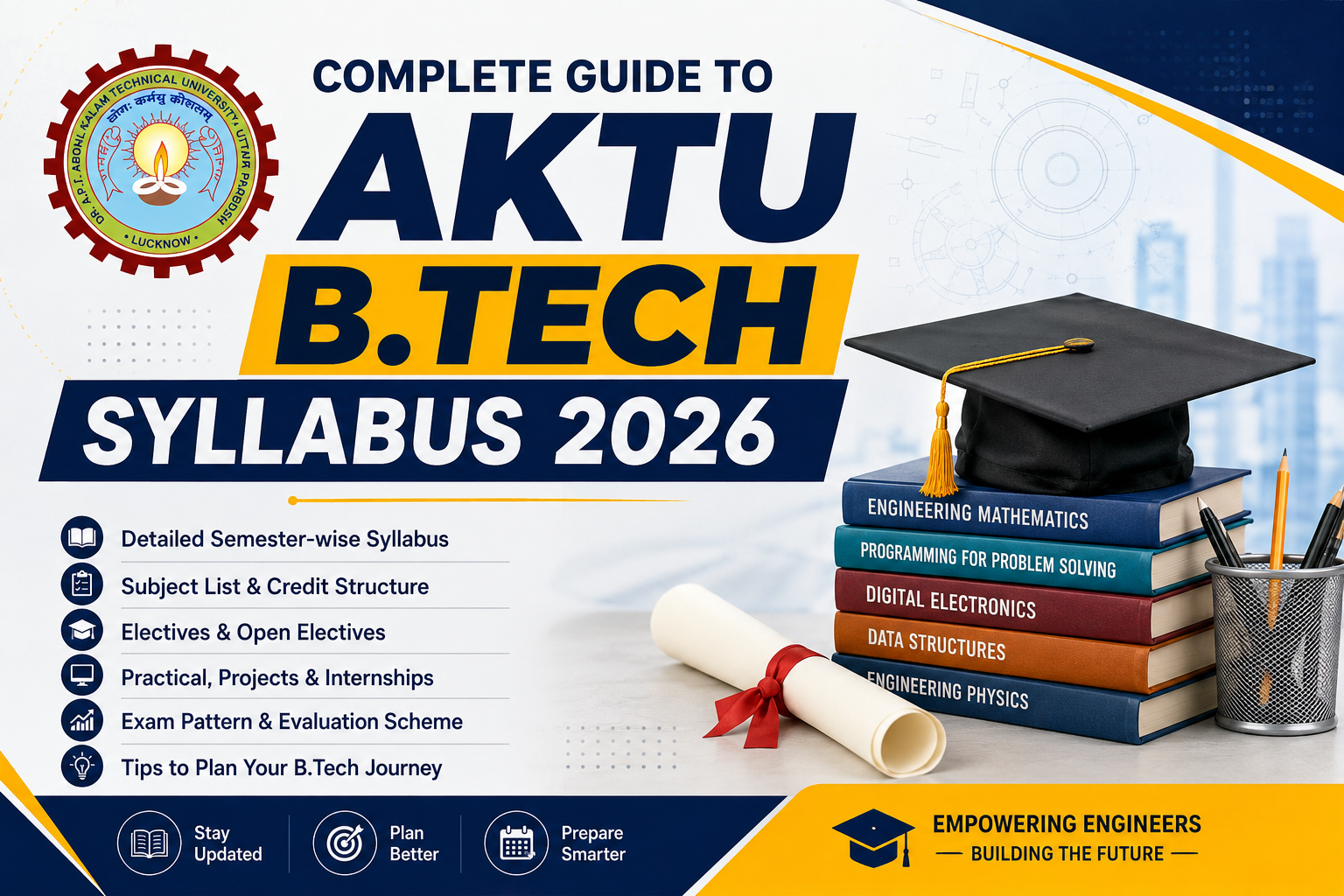
Engineering students at Dr. A.P.J. Abdul Kalam Technical University (AKTU) need a clear understanding of the AKTU B.Tech Syllabus to perform well in academics, semester examinations, internships, and placements. The syllabus acts as a roadmap that helps students focus on important subjects, practical labs, projects, and skill development throughout their four-year engineering journey.
Whether you’re a first-year student or preparing for your final semester, knowing the updated curriculum helps you manage your studies more effectively. AKTU periodically updates its curriculum to align with industry requirements and emerging technologies, making it essential for students to refer to the latest syllabus before every semester. The university also organizes syllabi semester-wise and branch-wise for easier access.
In this guide, we’ll cover everything you need to know about the AKTU B.Tech Syllabus 2026, including semester-wise structure, major subjects, benefits, preparation tips, and how to download the official syllabus PDFs.
What is the AKTU B.Tech Syllabus?
The AKTU B.Tech Syllabus is the official curriculum prescribed by Dr. A.P.J. Abdul Kalam Technical University for all affiliated engineering colleges.
It includes:
- Theory subjects
- Practical laboratory sessions
- Internal assessments
- Project work
- Industrial training
- Open electives
- Professional electives
- Credit distribution
- Examination pattern
The syllabus is designed to provide students with both theoretical knowledge and practical skills required by modern industries.
AKTU B.Tech Course Structure
The B.Tech program consists of:
| Course Duration | 4 Years |
|---|---|
| Total Semesters | 8 |
| Credits | Vary by Branch |
| Internal Marks | 30 |
| External Marks | 70 |
| Practical Exams | Yes |
| Major Project | Final Year |
Each semester introduces new technical concepts while gradually increasing practical exposure.
AKTU B.Tech Syllabus Semester-Wise Overview
First Year (1st & 2nd Semester)
The first year focuses on building engineering fundamentals common across all branches.
Major Subjects
- Engineering Mathematics
- Engineering Physics
- Engineering Chemistry
- Programming for Problem Solving
- Basic Electrical Engineering
- Basic Mechanical Engineering
- Engineering Graphics
- Soft Skills
- Environmental Science
- Workshop Practice
Labs
- Physics Lab
- Chemistry Lab
- Programming Lab
- Workshop
- Electrical Lab
The first year develops analytical thinking, communication skills, and programming basics before students move into branch-specific courses.
Second Year (3rd & 4th Semester)
From the second year onward, students begin studying subjects related to their engineering branch.
Example for Computer Science (CSE)
- Data Structures
- Digital Electronics
- Computer Organization
- Object-Oriented Programming
- Operating Systems Basics
- Database Management Systems
- Discrete Mathematics
- Computer Networks
Practical sessions become more intensive with coding assignments and mini-projects.
Third Year (5th & 6th Semester)
This phase focuses on advanced engineering concepts and industry-oriented subjects.
Popular CSE Subjects
- Operating Systems
- Computer Networks
- Theory of Computation
- Software Engineering
- Web Technologies
- Artificial Intelligence
- Data Analytics
- Machine Learning Basics
- Compiler Design
Students also complete:
- Mini Projects
- Technical Seminars
- Internship Training
- Industrial Visits
Final Year (7th & 8th Semester)
The final year prepares students for placements, higher studies, and industry.
Subjects usually include:
- Professional Electives
- Open Electives
- Major Project
- Internship
- Emerging Technologies
- Research Topics
Students work on real-world applications while improving problem-solving and technical skills.
Branch-Wise AKTU B.Tech Syllabus
The syllabus differs according to the engineering specialization.
Popular branches include:
- Computer Science Engineering (CSE)
- Information Technology (IT)
- Artificial Intelligence & Data Science
- Mechanical Engineering
- Civil Engineering
- Electrical Engineering
- Electronics & Communication Engineering
- Biotechnology
- Chemical Engineering
- Agricultural Engineering
Each branch contains core subjects along with elective courses.
Why is the AKTU B.Tech Syllabus Important?
The latest AKTU B.Tech Syllabus helps students:
Better Exam Preparation
Students know exactly which units are included in examinations.
Structured Learning
The syllabus provides a semester-wise study roadmap.
Placement Preparation
Core technical subjects asked in interviews come directly from the university curriculum.
Competitive Exams
Many GATE and PSU concepts overlap with university subjects.
Project Planning
Students can choose project ideas according to upcoming subjects.
Credit System in AKTU
AKTU follows a credit-based system.
Credits are assigned according to:
- Theory Classes
- Tutorial Sessions
- Laboratory Work
- Projects
- Internships
Students must earn the required credits to complete the degree successfully.
Practical Subjects Included
Engineering education isn’t limited to theory.
The syllabus includes:
- Computer Programming Labs
- CAD Labs
- Electrical Machines Lab
- Electronics Lab
- Database Lab
- Networking Lab
- Workshop Practice
- Industrial Training
Practical knowledge significantly improves placement opportunities.
New Technologies Included in Recent AKTU Syllabus
To meet industry demands, recent curricula increasingly incorporate topics such as:
- Artificial Intelligence
- Machine Learning
- Cloud Computing
- Internet of Things (IoT)
- Cyber Security
- Data Science
- Blockchain Basics
- Software Testing
- Full Stack Development
Students should always check the latest branch-specific syllabus because revisions may introduce new subjects or modify existing ones.
How to Download AKTU B.Tech Syllabus PDF
Students can download semester-wise syllabus PDFs by following these steps:
- Visit AKTUHub.
- Open the AKTU Syllabus section.
- Select your branch.
- Choose the semester.
- Download the latest PDF.
The website also provides previous year papers, notes, and study materials organized by course and semester.
Tips to Study the AKTU B.Tech Syllabus
Follow Unit-wise Study
Complete one unit at a time.
Prepare Notes
Short notes improve revision speed.
Solve Previous Year Papers
Practice important questions regularly.
Focus on Practical Subjects
Coding and lab subjects require hands-on practice.
Revise Weekly
Consistent revision improves retention.
Learn Beyond the Syllabus
Build additional skills through online courses and projects to strengthen placement readiness.
Common Mistakes Students Should Avoid
- Ignoring laboratory subjects
- Studying only before examinations
- Not following updated syllabus
- Skipping internal assignments
- Depending only on classroom notes
- Ignoring practical programming
Frequently Asked Questions (FAQs)
Is the AKTU B.Tech Syllabus the same for every branch?
No. The first year is mostly common, while later semesters contain branch-specific subjects.
Does AKTU update its syllabus regularly?
Yes. The university revises the syllabus periodically to keep it aligned with industry needs and academic standards.
Where can I download the latest AKTU B.Tech Syllabus?
You can download semester-wise syllabus PDFs from AKTUHub’s syllabus section.
Is the syllabus enough for placements?
The syllabus provides strong fundamentals, but students should also practice coding, projects, internships, and aptitude to improve placement prospects.
Are practical subjects compulsory?
Yes. Practical examinations, laboratory work, and project submissions are mandatory components of the B.Tech curriculum.
Conclusion
The AKTU B.Tech Syllabus is much more than a list of subjects—it is a structured academic framework that guides engineering students from foundational concepts to advanced technical knowledge over eight semesters. Understanding the syllabus helps students plan studies effectively, prepare for exams, build technical skills, and stay ready for placements and higher education.
For the best results, always use the latest semester-wise syllabus, revise consistently, complete practical work sincerely, and complement university learning with projects and industry-relevant skills. By following the curriculum strategically, you can maximize both your academic performance and career opportunities.