Currently Empty: ₹0.00
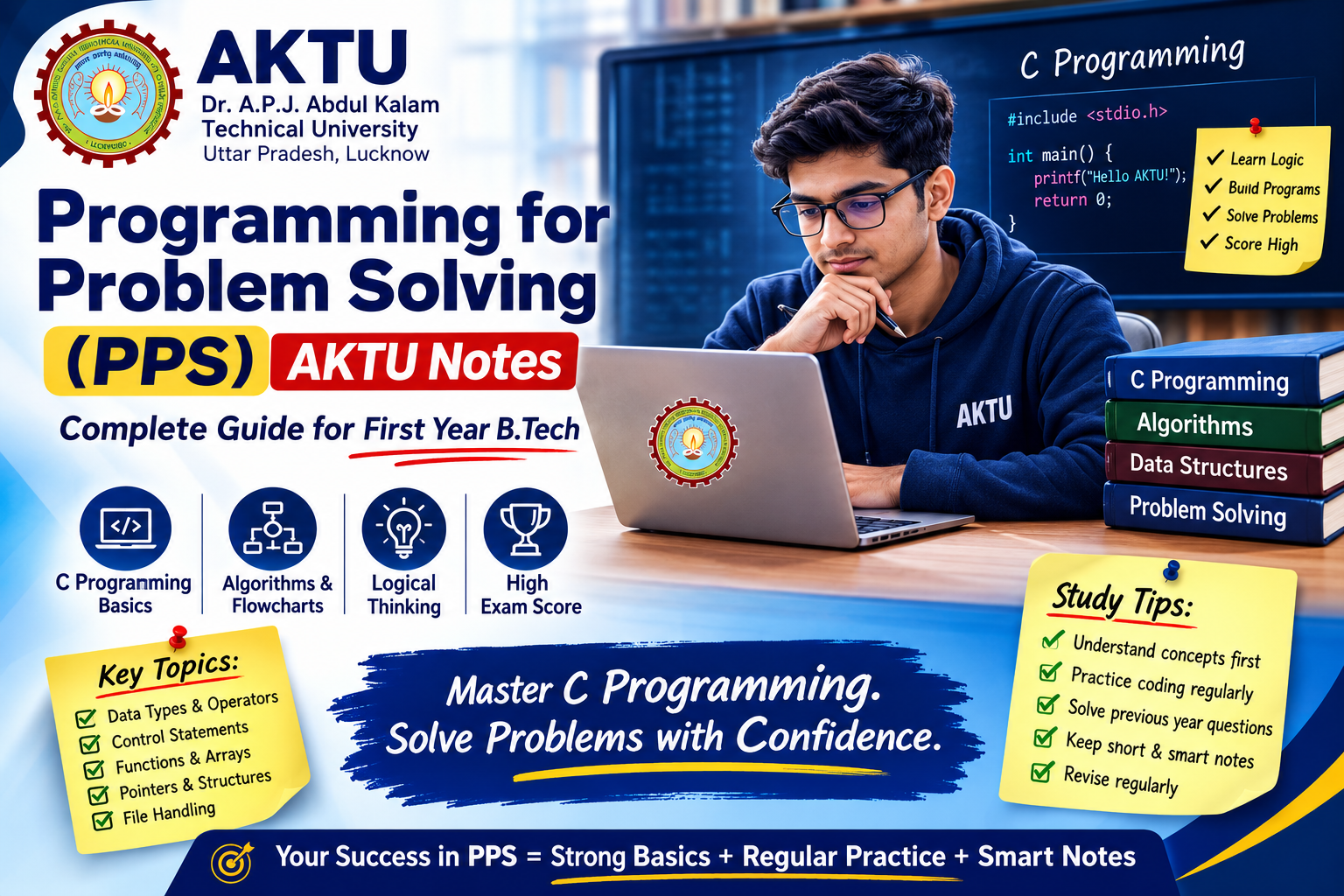
Programming is one of the most important skills for engineering students in today’s technology-driven world. The Programming for Problem Solving (PPS) subject in AKTU is designed to introduce students to programming fundamentals using the C programming language. It helps students develop logical thinking, problem-solving abilities, and coding skills that form the foundation for advanced programming subjects.
For many first-year B.Tech students, PPS can seem challenging initially. However, with the right approach, proper notes, and consistent practice, it becomes one of the most scoring and practical subjects in the curriculum.
What is Programming for Problem Solving (PPS)?
Programming for Problem Solving focuses on teaching students how to analyze problems and develop logical solutions using programming techniques.
The subject covers:
- Introduction to Programming
- Algorithms and Flowcharts
- C Programming Basics
- Data Types and Operators
- Control Statements
- Functions
- Arrays
- Strings
- Pointers
- Structures
- File Handling
These concepts help students build a strong programming foundation for future technologies and software development.
Why PPS is Important for AKTU Students
1. Builds Logical Thinking
Programming teaches students how to break complex problems into smaller manageable parts and solve them systematically.
2. Foundation for Advanced Subjects
PPS serves as the base for subjects such as:
- Data Structures
- Object-Oriented Programming
- Database Management Systems
- Operating Systems
- Artificial Intelligence
- Machine Learning
3. Improves Placement Opportunities
Programming skills are among the most sought-after skills in technical interviews and campus placements.
How to Study PPS Effectively
Understand Concepts Before Coding
Many students directly start memorizing programs. Instead:
- Learn the logic first
- Understand the syntax
- Analyze program flow
- Practice writing algorithms
Strong fundamentals make coding much easier.
Focus on C Programming Basics
Master the following topics:
Data Types
- int
- float
- char
- double
Operators
- Arithmetic Operators
- Relational Operators
- Logical Operators
- Assignment Operators
Input and Output Functions
- printf()
- scanf()
These are the building blocks of C programming.
Learn Control Statements Thoroughly
Control structures are among the most important topics in PPS.
Conditional Statements
- if
- if-else
- nested if
- switch
Looping Statements
- for loop
- while loop
- do-while loop
Practice multiple examples from each category.
Importance of Algorithms and Flowcharts
Before writing a program, students should learn how to:
- Identify the problem
- Create step-by-step solutions
- Draw flowcharts
- Develop algorithms
This improves problem-solving skills significantly.
Important Topics for PPS AKTU Notes
Functions
Functions help divide large programs into smaller reusable blocks.
Study:
- Function Declaration
- Function Definition
- Function Calling
- Recursive Functions
Arrays
Arrays are commonly asked in examinations.
Practice:
- One-Dimensional Arrays
- Two-Dimensional Arrays
- Matrix Operations
Strings
Learn string manipulation functions such as:
- strlen()
- strcpy()
- strcat()
- strcmp()
Pointers
Pointers are considered one of the most important topics in C programming.
Understand:
- Pointer Declaration
- Pointer Arithmetic
- Call by Reference
Structures
Structures allow storing different data types under one name.
File Handling
Topics include:
- Opening Files
- Reading Files
- Writing Files
- Closing Files
Best Strategy for Exam Preparation
1. Create Short Notes
Maintain concise PPS AKTU Notes containing:
- Syntax
- Important programs
- Definitions
- Flowcharts
- Algorithms
2. Practice Programs Daily
Spend at least:
- 30–60 minutes daily coding
- Writing programs manually
- Understanding outputs
3. Solve Previous Year Questions
Benefits include:
- Understanding question patterns
- Identifying important topics
- Improving speed and accuracy
4. Learn Common Programs
Practice programs related to:
- Prime Numbers
- Factorial
- Fibonacci Series
- Armstrong Numbers
- Matrix Operations
- String Operations
These are frequently asked in examinations and interviews.
5. Perform Dry Runs
Before executing code:
- Trace variables
- Predict output
- Identify logical errors
This improves debugging skills.
Common Mistakes Students Should Avoid
Memorizing Programs
Understand logic instead of memorizing code.
Ignoring Practical Sessions
Programming is a practical subject. Coding practice is essential.
Skipping Difficult Topics
Topics like pointers and file handling should not be avoided.
Last-Minute Preparation
Regular practice is far more effective than cramming before exams.
Recommended Resources
For better preparation:
- AKTU Syllabus
- Classroom Notes
- PPS Lab Manual
- Previous Year Question Papers
- Online Coding Platforms
- C Programming Reference Books
Tips for Scoring High in PPS
✅ Understand concepts deeply
✅ Practice coding regularly
✅ Solve previous year papers
✅ Prepare short notes
✅ Revise syntax frequently
✅ Focus on important programs
✅ Practice flowcharts and algorithms
Conclusion
Programming for Problem Solving is much more than an academic subject—it is the foundation of a successful engineering career. By developing strong logical thinking, understanding programming fundamentals, and practicing consistently, students can excel in both examinations and future technical roles.
Using well-organized PPS AKTU Notes, regular coding practice, and a structured study plan can help students score excellent marks and build confidence in programming.